The Coronavirus pandemic has affected organisations of all types in different ways, with IT departments especially impacted by the sudden shift to mass remote working.
Steve Capper moved into his current role as Global CIO of professional services firm SNC-Lavelin during the first quarter of 2020, just as the pandemic was about to take hold.
"I joined the company then went out to India, San Francisco, Montreal, then bang, I was back in the house," said Capper. "I didn't go into the office again. But I did manage to go out and see as many people as possible."
He acknowledged the challenges of keeping operations going during the early stages of the pandemic.
"We had 38,000 people at the time. How do you get them all connected and make sure they have [Microsoft] Teams? The single biggest thing we did to help was to get people at home working with video conferencing. People were quite self-sufficient and that really helped.
"But we struggled with our big engineering applications which need quite meaty machines to run them. That was a real struggle because people couldn't go to the office to use them. So we had to do clever things like getting people onto remote desktops, and we implemented VDI [Virtual Desktop Infrastructure] as fast as we could so people could work from anywhere."
Capper also explained how he stamped his own personality and managerial style across his organisation whilst working from home. Watch the video for more.
For the latest independent research on Unified Communictations from Delta, Computing's in-house analyst service, check this article: Microsoft versus Zoom versus Cisco - Should you opt for traditional UCC vendor or upstart?
Computing Delta surveyed more than 180 end users of different unified communication and collaboration (UCC) solutions. In this article we compare answers to find the winner from market leaders: Microsoft vs Zoom vs Cisco.
The marketplace for UCC - the combination of communications and collaboration tools into one solution - was already developing strongly prior to the pandemic. However, the pace of growth has accelerated as offices closed and employees adjusted to working full time from kitchen tables, bedrooms and home offices. UCC's value has skyrocketed in the last 18 months: 84 per cent of participants said they considered it more important since March 2020.
The vendors dominating the UCC market are a mix of the decidedly familiar - Microsoft 365 (M365) and Cisco Webex - and upstarts like Zoom, which went from being unheard of by the majority of individuals in 2019 to being the fastest-growing brand of 2020, and synonymous with video calling.
As part of Computing Delta's ongoing research into Microsoft versus Zoom versus Cisco - and other UCC products and services - our research team has been asking senior IT professionals about their preferences to help you answer the question:
Which UCC solution should I choose?
Computing Delta's analysis of this market, with interviews with more than 180 senior IT leaders using UCC technology, is available to Delta subscribers. More information, including comparisons with other vendors, is available in the Unified Communication and Collaboration Report. If you are looking for a platform comparison, this article provides a brief summary of the market leaders Microsoft vs Zoom vs Cisco.
What's the difference between Microsoft 365, Zoom and Cisco Webex?
Approach: All three platforms include video, audio, chat and file-sharing functionality. M365 integrates with the Microsoft cloud and various productivity apps, for real-time collaboration; Cisco is similar but prioritises on-premise integrations. Zoom specialises in audio and video, as well as large-scale event functionality.
Deployment: MS365 and Zoom are pure cloud platforms, while Cisco offers products for both on-premise (Cisco Unified Communications Manager) and cloud (UCM Cloud).
Ease of use: Microsoft is seen as the easiest app to use, although Zoom - with its clean UI - is a close second. Cisco rated poorly.
Pricing: Although Zoom has a generous free tier, Microsoft performed better on pricing overall thanks to its wide range of features and affordable tiers.
Adoption: M365 is widely used, boosting the adoption of Teams and other Microsoft tools to a level its competitors cannot match.
Microsoft vs Zoom vs Cisco - the background
It is hard to overstate the advantages that Microsoft has over its competition in the UCC marketplace. Microsoft has a huge existing installed base, thanks to Active Directory and Office 365 (now Microsoft 365). Microsoft Teams, which has replaced Skype for Business, slots seamlessly into the Microsoft identity, directory and productivity stack. From the perspective of users working at home, the integration of Teams into SharePoint and OneDrive enable tasks like file sharing.
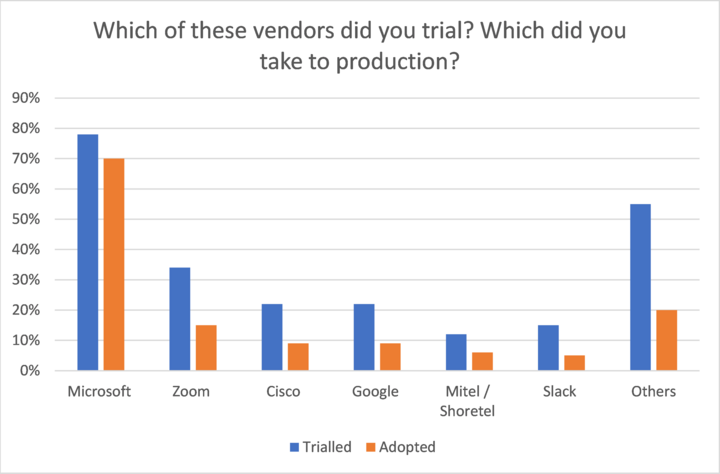
Not only did Microsoft poll the greatest awareness of their UCC solutions (the closest in terms of awareness was Zoom, with 71 per cent in contrast to Microsoft's 85 per cent), the proportions trialling M365 and Teams, then progressing into production, were almost triple that of Zoom and Cisco.
N = 188. Source: Delta
In fairness, direct comparisons between these vendors are difficult - which is why many of the organisations represented in our research used more than one UCC solution. While Microsoft Teams is part of the wider Microsoft cloud, Zoom is a more simple unified communications platform with video, audio conferencing and chat, plus much larger webinar functionality. There are many application integrations available but it's a more fragmented proposition overall.
Cisco Webex and Microsoft Teams are more comparable in terms of functionality (and cost), but Cisco's core strength is its networking and telephony installed base.
Microsoft vs Zoom vs Cisco - the tools
Of the three vendors under discussion, only Cisco offers its Unified Communications Manager products as an on-premise or cloud hosted product, in addition to the Webex cloud platform. Microsoft 365 and Zoom are purely cloud platforms.
For every single aspect of UCC functionality, Microsoft scores significantly more highly than its closest competition, as the graph below illustrates.
Microsoft
Microsoft Teams is the communications platform included within the Microsoft 365 cloud. Microsoft licences the product differently depending on whether you are a home, education, business or enterprise customer. M365 Enterprise brings together the Office 365 productivity options with Windows 10 Enterprise and Enterprise Mobility and Security.
Teams integrates with the productivity applications most of us highly familiar with. It includes chat and voice calling, as well as a shared workspace where users can edit their Microsoft files in real time.
M365 and Teams garnered a great deal of positive feedback, particularly on integration with the wider Microsoft stack. Negative sentiment was, mainly, for commercial reasons, although a small number of users commented on software bloat, a complex and frequently changing UI, and reliability issues.
Zoom
Zoom is a unified cloud communications platform. Its audio and video conferencing functionality, plus generous free tier, has propelled astronomical growth throughout 2020; but it also offers chat and large-scale conferencing and events functionality. It also has a large marketplace of integrations, including with Microsoft Teams and Slack.
Zoom licensing is straightforward, with free, pro, business and large enterprise editions. Zoom's simplicity is it's big strength. Its user-friendly and simple-to-navigate UI won praise, as did its stability and ability to host large scale events. Negative comments included a US-centric focus and cost of the premium tiers.
Cisco
The on-premise version of Cisco Unified Communications Manager includes telephony, video, messaging and presence. UCM Cloudis hosted in Webex data centres and extends office functionality to remote and mobile workers. Cisco also offers UCM on a hosted private cloud option.
WebEx has been around for a long time, and UCM Cloud will feel very familiar to businesses used to Cisco's telephony and conferencing tools. Like Zoom, Cisco has built an extensive library of integrations, including with Microsoft and Google.
Cisco users emphasised the integration capabilities and the stability and robustness of the Cisco platform. Support was also a strength. However, the complexity and expense of the Cisco suite were the most frequently cited drawbacks.
Microsoft vs Cisco vs Zoom - at a glance
Vendor
Positives
Negatives
Microsoft
Integration with AD and productivity applications
Outages
Rich functionality
Complex UI
Inflexible licensing model
Cisco
Stability
Expensive
Integration with on-premise telephony and networking
Complexity and management burden
Zoom
Simple UI
Expensive at scale
Handles large virtual events smoothly
Minimal UK support
Regulatory concerns
Pricing
Microsoft Teams
The free version of Teams can host up to one hundred participants, but it is likely unsuitable for anything other than smallest businesses due to the lack of important features, like enterprise security and 24 x 7 support. However, most firms will be signed up to Microsoft's M365 cloud anyway, which includes Teams.
Microsoft has multiple licensing packages available within both Business and Enterprise licence families. Prices range from £3.80 per user per month for Business Basic, right up to £48.10 per user per month for the full Enterprise E5 suite.
Licence bundles have been very successful in terms of growing the M365 cloud, but participants in our research often cited the complexity of the licencing model and Microsoft's inflexibility when it comes to negotiation.
Zoom
Zoom has a very clear and simple pricing structure, which is likely to have played a part in the company's rapid growth trajectory when video calling became essential. There is a free product, but the 40-minute time limit on meetings limits its usefulness. The Pro licence comes in at £119.90 per licence per annum and allows up to one hundred meeting participants, social media streaming, recording etc. Business costs £159.90 per licence per annum, adding single sign on and another 200 participants, as well as recording transcripts. The final level is Enterprise, at £192 per annum with a minimum of fifty user accounts. Enterprise-scale firms can host up to five hundred participants and benefit from unlimited cloud storage.
The sentiment around Zoom is best surmised as, "Great VC platform but expensive to scale in the longer term."
Cisco
Licensing and pricing for enterprise-sclae Cisco deployments are as complex and flexible as the deployments themselves and impossible to quote here on a per user/per annum basis. However, what we can do is examine WebEx suite pricing, which is broadly comparable to Zoom and Teams in terms of features and functionality.
Again, a free version is available for up to one hundred users, but the product is limited to 50-minute video calls and online support only. A Starter package, at £11.25 per host per month, provides almost the same functionality in terms of audio calls, messaging and collaboration as the more expensive business and enterprise levels, but is limited to up to 50 host licenses. Business, at £22.50, allows up to one hundred host licences. Any organisation requiring more than one hundred host licences will need to subscribe to the Enterprise service, for which list prices are not published.
Cisco licencing was considered complex, inflexible and expensive by many of the organisations participating in our research.
Conclusions
One of the most telling findings in our UCC research was that the vast majority of those who participated used more than one UCC solution. Thirty-seven per cent used two, and 21 per cent used three. A handful used up to four or five separate solutions. On the one hand, this does call into question the idea of 'unified' communication and collaboration. However, after examining the relative strengths and weaknesses, pricing and licencing of the three leading vendors it makes perfect sense.
If you've paid for MS Teams (and you probably have) then you may as well use it, particularly if you need to share and edit Microsoft files (which you probably do). It integrates perfectly with the hybrid and cloud infrastructures that dominate the enterprise technology landscape. However, many end users find it less user friendly and robust than something like Zoom, which offers a simple, stable VC platform suitable for one-to-ones as well as larger team calls. It will be interesting to see whether Zoom continues to pick up new users over the next year as we all gradually (hopefully) return to offices at least some of the time. Did it just fulfil a specific need, and will those annual subscriptions be renewed in 2022?
Cisco is likely to have scored as poorly as it did in our research at least partly because one of its biggest strengths is how well it integrates with physical networking and telephony - not something that has been a huge priority over the last 18 months. The same factors which may cause a drop off in Zoom subscribers may well work in Cisco's favour over the same period of time - although on-prem popularity has been declining for years.
The bill aims to set 'fair, clear, and enforceable' rules to protect competition within the app market
Three US senators introduced a bill to promote competition in the app store space, which Apple and Google currently dominate.
The Open App Markets Act, sponsored by Democratic Senators Amy Klobuchar and Richard Blumenthal, as well as Republican Senator Marsha Blackburn, aims to set 'fair, clear, and enforceable' rules to protect competition within the app market, and to strengthen customer protection.
If successful, the Act will bar large app stores (with 50 million+ US users) from requiring developers to use their own payment system. It will also prevent them from punishing developers that offer different conditions or prices through alternative app stores.
The bill also aims to keep app stores from disadvantaging certain developers, and allow for the growth of third-party app stores.
The Senators said Google and Apple enjoy 'gatekeeper control' of the two main mobile operating systems, Android and iOS, as well as their app stores, which restricts consumer choices.
Blumenthal expects that the new legislation will "tear down coercive anticompetitive walls in the app economy," and will give consumers more choices.
It would also give smaller tech firms a "fighting chance," he said.
"I'm proud to partner with Senators Blackburn and Klobuchar in this breakthrough blow against Big Tech bullying," Blumenthal added.
Klobuchar said competition was vital for protecting smaller firms and consumers, spurring innovation, and promoting economic equity.
"By establishing new rules for app stores, this legislation levels the playing field and is an important step forward in ensuring an innovative and competitive app marketplace," she added.
The new bill has been introduced to the US Senate about a month after a bipartisan coalition of US state attorney generals filed an antitrust lawsuit against Google. They accused the company of abusing its control of the Android app store to thwart competition and force consumers into in-app payments.
The lawsuit alleged that Google was unlawfully forcing app developers to go through the Google Play Store to reach users, and to pay an 'extravagant' 30 per cent commission on app purchases.
The legal challenge also accused Google of using 'misleading' security warnings to keep developers and consumers in the Play Store.
It's not only Google at risk: the stakes are also high for Apple, which earns billions of dollars through its App Store every year. Apple's App Store is the only place iPhone, iPad and Apple Watch users can download apps.
In June, Apple published a 16-page report that defended its tightly policed App Store, and explained why allowing iOS users to install third-party apps would be a huge security risk for users.
The company argued that allowing users to sideload (download apps from outside the App Store) would simply open the doors for scammers and malware.
Commenting on the new bill, Apple told Reuters that its app store was 'an unprecedented engine of economic growth and innovation, one that now supports more than 2.1 million jobs across all 50 states'.
But the USA is not the only country where the tech giants face criticism over their app store policies.
In March, the UK Competition and Markets Authority (CMA) announced that it was investigating Apple over complaints that the company's terms and conditions for app developers are unfair and anti-competitive.
The company is also facing a probe by the Dutch competition authorities, who are nearing a draft decision.
The European Commission has four ongoing antitrust investigations into Apple, three of which involve the App Store.
Sascha Giese, Head Geek™ at SolarWinds, explains the benefits of ITSM
It's not always easy to plan for the future. As painstaking as it is, this level of forward thinking should also be applied by IT pros when adopting a new IT Service Management (ITSM) software or reviewing your existing investment. This process is also about laying solid foundations for the future, so the decision around which ITSM platform is right for you shouldn't solely apply to your needs and environment right now. It requires IT pros to evaluate an organization's vision for the future and how the platform can accommodate its growth.
Building in the Cloud
Not everyone who buys a home wants and needs the same things. Some will have their heart set on a Victorian-built property with oodles of personality and decades of idiosyncrasies, while others will want a new build fully customized to the buyer's tastes, leaving the difficult task of furnishing, designing, and anything else to someone else. This latter option certainly has some parallels with opting for a cloud based ITSM solution.
The cloud option allows IT pros to tailor the environment and service offerings to their organization's culture and objectives, relying on the cloud service provider to manage the hard graft. Its agility and flexibility can enable IT pros to ensure more secure service offerings—a vital consideration as the security landscape continues to evolve and teams navigate hybrid infrastructures and become more geographically diverse.
Here are some of the key benefits for organizations looking to invest in a cloud-based service desk:
· Scalability: The cloud-based service desk can be moulded and configured in alignment with a business' growing needs, regardless of its size or service maturity. Tweaking a configuration can be done organically and instantaneously, without disrupting users' experience, while changes can be made without breaking the bank or dedicating hours to carrying them out.
· Efficient upgrades and enhancements: A cloud-based service desk can ensure an organization is leveraging the latest version of a multi-tenant solution. An ITSM vendor is charged with testing and rolling out new features, meaning teams won't need to manage upgrades themselves. This reduces the risk of downtime and maintains availability of the service desk to users.
· Reduced maintenance and overhead: A cloud-based ITSM vendor will deliver maintenance and upgrades to the system while monitoring performance, and by outsourcing these responsibilities, teams can spend more time focusing on business-critical needs and how the service desk can support them.
· Improved collaboration: It's vital for communications in organizations to be optimized, especially as more businesses embrace hybrid in-person and remote work environments, and workforces become increasingly disparate. Cloud-based ITSM can do just that, extending communication channels to eliminate service silos, resulting in more cross-functional visibility and collaboration.
· Tighter security: By centralizing services and data with a cloud-hosted service desk, teams will achieve greater visibility, allowing them to introduce more automated methods of securing their ecosystem.
Securing Your ITSM Environment for the Future
Any home should offer security, both now and in the future. A front door hanging off its hinges may be a welcome sign for would-be intruders, but for purchasers this urgently needs addressing, while further precautions may be taken down the line to ensure a greater sense of safety.
While security may not be the absolute top of the list when selecting a service desk, it's vital for IT pros to know they can introduce modern and automated forms of security to protect users, data, and the environment for the future. So, how can they do this?
A first step would be to look at users and access, reviewing the steps you've taken to secure who can use the ITSM platform and what can they see. It may be worth integrating Active Directory or access management system to streamline user provisioning, deprovisioning, and data access. Or, connecting user registries to the ITSM platform to ensure the user base is current while key user attributes (department, direct reports, location) are accounted for.
Additionally, IT pros can consider implementing login policies such as single sign-on (SSO) and multi-factor authentication (MFA), with the former giving users a seamless experience to access the service desk, removing the need for employees to remember yet another password, while also driving value and traffic to the platform. SSO can also mitigate security risks when paired with MFA, as it requires users to provide several different pieces of evidence to confirm their identities.
Whether through cloud-based providers or more secure service management, investing in ITSM today can build strong foundations for a business' future.
The hacker claims the $611 million theft was intended to expose a weakness in Poly Network's system
A hacker who stole more than $600 million in one of the largest ever cryptocurrency heists has returned over half of what they took.
Poly Network, a decentralised finance (DeFi) platform, said the hacker had sent back $256 million on Binance Smart Chain, $3.3 million in Ethereum and $1 million in Polygon as of 11th August.
The company added that there was still $269 million in Ethereum and $84 million in Polygon missing.
$260 million (As of 11 Aug 04:18:39 PM +UTC) of assets had been returned: Ethereum: $3.3M BSC: $256M Polygon: $1M
The remainings are $269M on Ethereum, $84M on Polygon
Tom Robinson, co-founder of blockchain analytics firm Elliptic, shared a post where the attacker said they had discovered a flaw in Poly Network's system, and decided to transfer the money to another account.
The aim of the attack was to expose the security vulnerability before it was exploited by "an insider," the hacker said.
They also claimed to have used anonymous IPs and email addresses to remain completely protected.
"The Poly Network is a decent system. It's one of the most challenging attacks that a hacker can enjoy. I had to be quick to beat any insiders or hackers," the person said.
"I didn't want to cause real panic of the crypto world. So I chose to ignore shit coins, so people didn't have to worry about them going to zero."
The attacker broke into Poly Network on Tuesday, stealing about $611 million worth of crypto currencies.
Poly Network swaps tokens across different blockchains, including Bitcoin, Ethereum, Ontology, Elrond, Neo, Ziliqa, Switcheo, Binance Smart Chain and Huobi ECO Chain.
After identifying the attack, Poly urged crypto exchanges to block the funds that were taken.
'We call on miners of affected blockchain and crypto exchanges to blacklist tokens coming from the above addresses,' it said on Twitter, providing three addresses where the assets were transferred.
The company also urged the hacker to return all stolen assets.
Important Notice: We are sorry to announce that #PolyNetwork was attacked on @BinanceChain@ethereum and @0xPolygon Assets had been transferred to hacker's following addresses: ETH: 0xC8a65Fadf0e0dDAf421F28FEAb69Bf6E2E589963 BSC: 0x0D6e286A7cfD25E0c01fEe9756765D8033B32C71
According to reports, Slowmist Technology and other security researchers were able to find identifying information about the hacker, including an IP address, email, and the Chinese cryptocurrency exchange that was used in the heist.
On Wednesday, the hacker sent a message to Poly Network stating that they were "ready to return" the funds.
The DeFi platform provided three crypto addresses to the hacker to transfer the assets.
The DeFi sector has already registered losses of $474 million in the first eight months of the year, according to Reuters.
"Just eight months into 2021 and DeFi hacks, thefts and frauds have already surpassed the total DeFi crimes from 2020," Dave Jevans, CipherTrace's chief executive officer, told Reuters.
While the Poly Network hack might shake the confidence of people who rely on crypto exchanges, Elliptic's Robinson told CNBC that it usually difficult for hackers to launder or cash out cryptocurrency, "due to the transparency of the blockchain and the use of blockchain analytics." Poly Network's ability to see and blacklist addresses is a perfect example.
Such incidents therefore might discourage attacks.
"In this case the hacker concluded that the safest option was just to return the stolen assets," Robinson added.
Once again, Amazon and Microsoft are in dispute over a multi-billion dollar cloud contract - but this time, Microsoft is on the attack
The USA's National Security Agency (NSA) has awarded a cloud computing contract worth up to $10 billion to AWS, but Microsoft has challenged the decision.
News of the contract first emerged last month, after Washington Technology Daily reported Microsoft had claimed the NSA did not conduct a 'proper evaluation' before awarding the multi-billion dollar contract, which is code-named WildandStormy.
Microsoft insists that, had the NSA conducted a proper evaluation, it would not have selected AWS as the winner.
The Windows-maker filed a bid protest with the US Government Accountability Office (GAO) on 21st July 2021 - about two weeks after the NSA announced AWS as the winner.
In a statement to Nextgov, Microsoft saidit was exercising its legal rights and 'will do so carefully and responsibly'.
An NSA spokesperson confirmed Microsoft had filed a protest. They said the Agency "will respond to the protest in accordance with appropriate federal regulations".
The GAO is expected to announce a decision by 29th October 2021.
The NSA and the Department of Defense (DoD) have taken many steps to introduce commercial cloud computing capabilities in recent years.
The NSA, which currently uses the on-premises GovCloud as its primary classified data repository, is pursuing a Hybrid Compute Initiative to move its intelligence data to servers operated by a commercial cloud provider.
In November 2020, the CIA awarded its Commercial Cloud Enterprise (C2E) contract to five cloud firms - Microsoft, AWS, Oracle, Google and IBM - who now compete with each other for specific task orders.
The contract award for WildandStormy project comes on the heels of a bitter and prolonged dispute over the DoD's Joint Enterprise Defense Infrastructure (JEDI) cloud contract, also worth up to $10 billion.
The DoD awarded the JEDI contract to Microsoft in 2019, but AWS challenged the decision in lawsuits. The DoD eventually went back on its choice last month, and plans to re-tender the contract.
The DoD began the JEDI project as part of a broader digital transformation process for the Pentagon, which will involve a general-purpose cloud service for the US military. Amazon was long seen as the favourite for the deal, until Microsoft emerged as the winner in October 2019.
In its lawsuit, the company argued that Trump had influenced the bidding process because of his ongoing dispute with Jeff Bezos, owner of Amazon and The Washington Post.
Amazon also argued in court that the JEDI tender was undermined by evaluation errors. In response, the DoD stated that it had 'completed its comprehensive re-evaluation of the JEDI Cloud proposals' and 'determined that Microsoft's proposal continued to represent the best value to the Government'.
The DoD said last month that it was cancelling the contract due to ‘evolving requirements, increased cloud conversancy, and industry advances'. The Department also began a new procurement process, open to bidding from multiple companies.
US cyber security giant NortonLifeLock has announced that it is buying Czech rival Avast in a cash and stock deal, at a total value of more than $8 billion.
It is unclear what the new group will be called, but Avast and NortonLifeLock said in a joint press release that the merger will create a 'mega' IT security firm, devoted to protecting 500 million consumers from both companies.
The group will generate $3.5 billion in annual revenue.
The new company will be listed on the Nasdaq - as opposed to the London Stock Exchange, where Avast is currently listed - and operate through dual headquarters in Tempe, Arizona and Prague, Czech Republic.
The deal is expected to close in mid-2022, pending regulatory approval. Once it is complete, Avast CEO Ondrej Vlcek will become NortonLifeLock's new president and join the board, while Norton chief Vincent Pilette will serve as CEO of the expanded group.
The respective boards of directors of the two cyber security firms said they see the deal as an opportunity to 'create a new, industry-leading consumer Cyber Safety business, leveraging the established brands, technology and innovation of both groups to deliver substantial benefits to consumers, shareholders, and other stakeholders.'
The combined group hopes to tap a market of 5 billion internet users, while also focusing on creating products for small businesses.
UK-listed Avast has been offering both free and paid antivirus software for years, and has about 435 million 'freemium' subscribers. It offers a free, basic product to users and then tries to turn them into paying customers with more advanced software.
According to Bloomberg, Pilette said in a call with reporters on Wednesday that about 1,000 jobs are at risk in the combined group, due to overlaps in responsibility.
"Combined, we have roughly a little bit less than 5,000 employees and we'll run the company moving forward at about 4,000," he said.
The job cuts will affect both firms and will be implemented across all geographies.
The Avast acquisition comes a few months after Norton bought German security firm Avira, for around $360 million in an all-cash deal.
Pilette said at the time that adding Avira would help NortonLifeLock to accelerate its overseas growth and "expand our go-to-market model with a leading freemium solution."
Amazon declares most of its revenues in low-tax Luxembourg - enough that, if all the sales were genuinely made there, it would have supplied about £78,000 worth of goods to each resident
Amazon reported up to £8.2bn of its UK sales in Luxembourg in 2019, to avoid paying the higher rates in the UK, a new analysis by trade union Unite has found.
The report, seen by The Independent, claims that Amazon declared £13.7 billion of UK sales in its US accounts in 2019, but reported just £5.5 billion in sales in filings for its UK-based firms.
The company declared €57 billion (£48.3 billion) of revenue in Luxembourg in 2019. That would mean it sold about £78,000 worth of goods and services to every person in the country.
The analysis, led by chartered accountant Vivek Kotecha, examined all of Amazon's publicly disclosed information to infer how much tax the company may be avoiding in the UK.
The researchers examined accounts for 19 of Amazon's UK-registered companies, including its warehouses, logistics operation and the Internet Movie Database (IMDb). They estimated that the retail firm paid a maximum of £84 million on its profits in UK tax - about £46 million less than would have been expected.
How does it work?
Amazon is able to shift revenues out of the country where they were actually made through its subsidiaries - an option not available to smaller firms. Unite argues that this gives large firms, especially those in the tech sector, an unfair advantage.
Amazon in particular uses its subsidiary Amazon EU Sarl, which is based in Luxembourg. Anyone buying from Amazon in the UK is actually billed by this subsidiary.
According to reports Amazon EU Sarl had just over 4,300 employees in 2019 and recorded revenues of €32.2 billion (£27.3 billion) - an average of €7.5 million (£6.4 million) per employee. That is about 36 times higher than staff at Amazon's subsidiares in the UK.
Unite has demanded a public inquiry into Amazon's tax arrangements.
Labour MP and Treasury Committee member Emma Hardy expressed concerns over the findings, and backed Unite's call for an investigation.
"I don't want a tax system that takes money from ordinary people to subsidise the growth of the world's biggest anti-union company," she said.
Atul K Shah, professor of finance at City University, said the findings provide a "long overdue A to Z of Amazon's UK tax avoidance".
In a statement to The Independent, Amazon rejected the report and said the discrepancy was because most of its sales to UK shoppers were booked by UK branches of one of its Luxembourg companies - although this simply confirms the report's findings.
The company said it had reported all the figures to HMRC.
"Our UK retail and Amazon Web Services revenues are recorded here in the UK and reported directly to HMRC," a spokesperson said.
"Our total tax contribution in the UK was £1.1 billion during 2019 - £293 million in direct taxes and £854 million in indirect taxes."
The spokesperson declined to disclose how much corporation tax the company paid on its UK sales in 2019.
Questions over Amazon's tax practices were also raised in May, after its corporate filings in Luxembourg showed that the company paid zero corporation tax in Europe last year, despite record sales income of around £38 billion.
Accounts for Amazon EU Sarl revealed that the Luxembourg unit made a €1.2 billion (£1 billion) loss and therefore paid no tax. Moreover, the unit was handed €56 million (£47 million) in tax credits to offset future tax bills.
Last month, Amazon was accused of profiting from price gouging at the height of the pandemic - while vulnerable people depended on home deliveries.
Amazon denied the accusations, stating that it terminated the accounts of sellers who tried to take advantage of the health crisis.
In February, bosses of leading stores in the UK, including Tesco, wrote a letter to Rishi Sunak, urging him to reform business rates to help them compete with companies like Amazon.
Amazon's UK sales in 2020 were around £19.3 billion, up 51 per cent since 2019, according to official figures. However, researchers at real estate adviser Altus Group estimate that Amazon's overall business rates bill for 2020-2021 was around £71.5 million - just 0.37 per cent of its retail sales.
High street retailers, in comparison, paid about 2.3 per cent of their annual retail sales in business rates before the pandemic, according to researchers.
Employees who refuse to sign new contract risk losing their jobs
Teleperformance, a call centre company working with Uber, Apple and Amazon, is installing AI-powered cameras at employees' homes to observe and record their workspaces, according to an investigation by NBC News.
Six Teleperformance workers based in Colombia told NBC they are being pressured to sign a new, non-negotiable contract that grants their employer the right to install cameras in their homes, for monitoring purpose.
Employees who refuse to sign have been warned they may lose their jobs.
The use of the cameras is not limited to Colombia: Teleperformance, a French firm, operates in 80 countries around the world.
The contract, first issued in March, requires workers to agree to share their biometric data like photos and fingerprints. They must also share video streams from the camera.
Employees said they were concerned about the contract, which enables Teleperformance to monitor them in real-time. The AI-based system also scans the entire room for objects like smartphones, paper and other items, in accordance with the firm's 'Clean Desk Policy'.
A clause in the contract also requires employees to agree to (notoriously unreliable) polygraph tests, if requested.
"The contract allows constant monitoring of what we are doing, but also our family," said a worker on the Apple account who was not authorised to speak to the news media.
"I think it's really bad. We don't work in an office. I work in my bedroom. I don't want to have a camera in my bedroom."
Teleperformance has a workforce of around 380,000 people in more than 80 countries. The company's website says it 'integrates advanced technology with a human touch' to offer 'remarkable' experiences to customers.
Teleperformance spokesperson Mark Pfeiffer told NBC that the new contract is meant to "[ensure] data security compliance, since many employees have access to sensitive client data during work." He added that "privacy and respect" are "key factors in everything" they do.
Apple and Amazon said they did not ask Teleperformance to monitor employees working on their projects.
Apple spokesperson Nick Leahy said that the company "prohibits the use of video or photographic monitoring by our suppliers, and have confirmed Teleperformance does not use video monitoring for any of their teams working with Apple".
Uber acknowledged that it uses camera monitoring services from Teleperformance to ensure that only authorised workers access sensitive customer data, and that screen data is not being recorded.
The company does not require any additional monitoring, the spokesperson added.
The company says that the incident affected only some of its internal servers, which were taken down and isolated
Taiwan-based computer hardware firm Gigabyte has reportedly fallen victim to a cyber attack from ransomware group RansomEXX.
In a ransom note posted a dark web page, the group claimed that they were able to steal 112GB of data from an internal Gigabyte network as well as the American Megatrends Git Repository.
"We have downloaded 112 GB (120,971,743,713 bytes) of your files and we are ready to PUBLISH it," the hackers said in their ransom note, according to Bleeping Computer.
"Many of them are under NDA (Intel, AMD, American Megatrends)," it added.
"Leak sources: newautobom.gigabyte.intra, git.ami.com.tw and some others."
The page is reportedly hosted on a dark web portal used by RansomExx operatives to post their extortion demands and leak data from companies that refuse to pay.
Along with their ransom note, the hackers also posted the screenshots of documents from Intel, AMD and American Megatrends that are under a non-disclosure agreement.
Megatrends creates firmware for some computer manufacturers and Chromebook makers.
The cyber attack reportedly occurred on the night of 3 August, forcing the company to shut down some of its system in Taiwan. It affected multiple websites of the company, including its support site. Some customers complained that they were unable to access support documents or receive updated information about RMAs.
In a statement to Chinese news site United Daily News, Gigabyte confirmed that some of its internal servers were affected as a result of the attack.
The company is currently investigating how the attackers were able to breach its systems and steal data from its systems. Local law enforcement has also been notified about the incident.
According to media reports, RansomEXX group has become more active in recent months, hitting Ecuador's state-run Corporación Nacional de Telecomunicación (CNT) and Italy's Lazio region.
The gang has also victimised some other high-profile organisations in the past one year, including the Texas Department of Transportation (TxDOT), Konica Minolta, IPG Photonics, Tyler Technologies and Brazil's government networks.
Last month, another cyber gang, which stole a wealth of data from game publishing giant Electronic Arts (EA), also dumped their haul on an underground forum, after failing to extort the firm.
The gaming firm declared the data breach on 10th June, and a spokesperson said that only a "limited amount" of data was stolen.
Hackers, however, claimed that they had stolen 780GB of data, which they were willing to sell for $28 million.
Earlier this year, cyber criminals behind the ransomware attack on the Scottish Environmental Protection Agency (SEPA) also posted online about 4,000 stolen files, after SEPA declined to pay ransom to the group.